.webp)
How to Keep AI-Generated Fashion Imagery Consistent Across a Full Catalogue


Answer: AI-generated fashion imagery loses consistency when each image is produced in isolation, so faces, bodies, lighting, cropping, and garment details drift from one shot to the next. The fix is to calibrate the brand's look once, as a fixed set of avatars, poses, camera views, and lighting, then apply it automatically across every SKU rather than regenerating it each time. Graswald AI is built around this approach, producing brand-calibrated on-model imagery that holds a single visual standard across an entire catalogue.
A quick note on terms before we start. What shoppers and search engines often call AI fashion models are, more precisely, AI avatars: brand-owned generated figures that a brand configures once and reuses. We use AI avatar throughout the rest of this piece. The distinction matters, because the whole question of consistency turns on whether those avatars, and the look around them, are fixed and reusable or generated fresh every time.
What causes brand inconsistency in AI-generated imagery for luxury fashion campaigns?
A luxury campaign is a tightly controlled thing. A creative director fixes a model, a lighting setup, a styling language, a crop, and a mood, and every frame ladders up to it. The trouble starts when that visual language has to travel. Imagery shot for the hero styles has to stretch across colourways that were never shot, secondary placements, market variations, and the long tail of the catalogue. Each of those extensions tends to be produced separately, at a different time, sometimes with a different tool or a different shoot, and the look erodes at every hop.
General-purpose AI tends to make this worse rather than better. Text-to-image tools and generic generators build each image from scratch with no persistent memory of the brand's look. Ask for the same model twice and you get two different people. Skin tone, hair, facial structure, body type, the angle of the light, and the tightness of the crop all shift from one generation to the next. Garment details suffer most of all: logos warp, prints break, and seams and drape stop behaving like real fabric. In an industry where the difference between a ruched sleeve and a gathered one carries meaning, that is not a small problem. The output reads as a pile of one-offs, not a catalogue with a single standard.
This matters more in fashion than almost anywhere else, and more still at the luxury end. Brand consistency is the asset. A house has spent years training its customer to recognise a look, and imagery that drifts, even slightly, reads as off-brand. Off-brand reads as risk. This is the one industry where close enough is not close enough, which is exactly why teams are right to be cautious about where AI fits and where it does not.
What brands try, and why it falls short
There are three common routes to covering a catalogue, and each has a ceiling.
The first is reshooting or extending the studio shoot. It produces consistent imagery, because a human team controls every variable, but it cannot cover a full catalogue economically. Shoot days are finite, samples arrive late, and the long tail and colourway expansions are the first things cut when the schedule runs out. The result is consistency for the hero styles and gaps everywhere else. The visual identity the brand invested in reaches only the products the shoot schedule reached.
The second is general-purpose AI tools. They are fast and inexpensive, but consistency is the one thing they cannot promise, for the reasons above. They solve coverage and lose the brand, which is the trade most fashion teams are unwilling to make.
The third is self-serve, per-image AI apps. These are a genuine step up for a small brand generating a handful of images. Their limitation is that consistency is per-image or per-batch. There is no way to lock a brand's look once and enforce it across thousands of SKUs, seasons, and channels, because nothing in the tool remembers the standard between sessions. What works for 20 images does not hold for 20,000. This is the gap that becomes obvious the moment a brand tries to move from a pilot to its actual catalogue, and it is the same gap multi-brand retailers hit when every vendor delivers something different.
How brand-calibrated on-model imagery stays consistent across a catalogue
The structural fix is to stop treating each image as a fresh generation and start treating the brand's look as a fixed, reusable profile. That means calibrating the pieces that drift, once, and applying them automatically rather than hoping each generation lands in the same place.
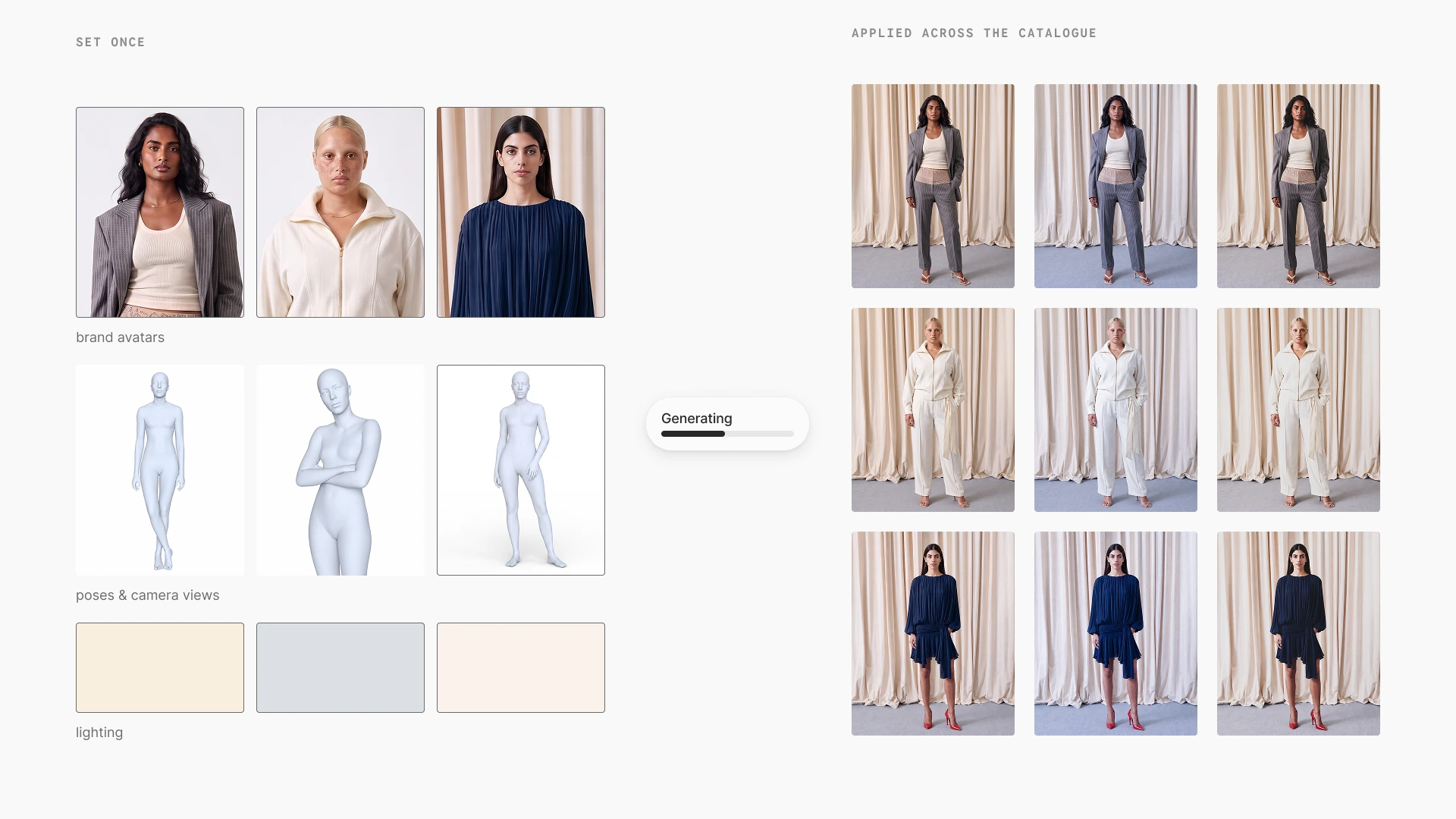
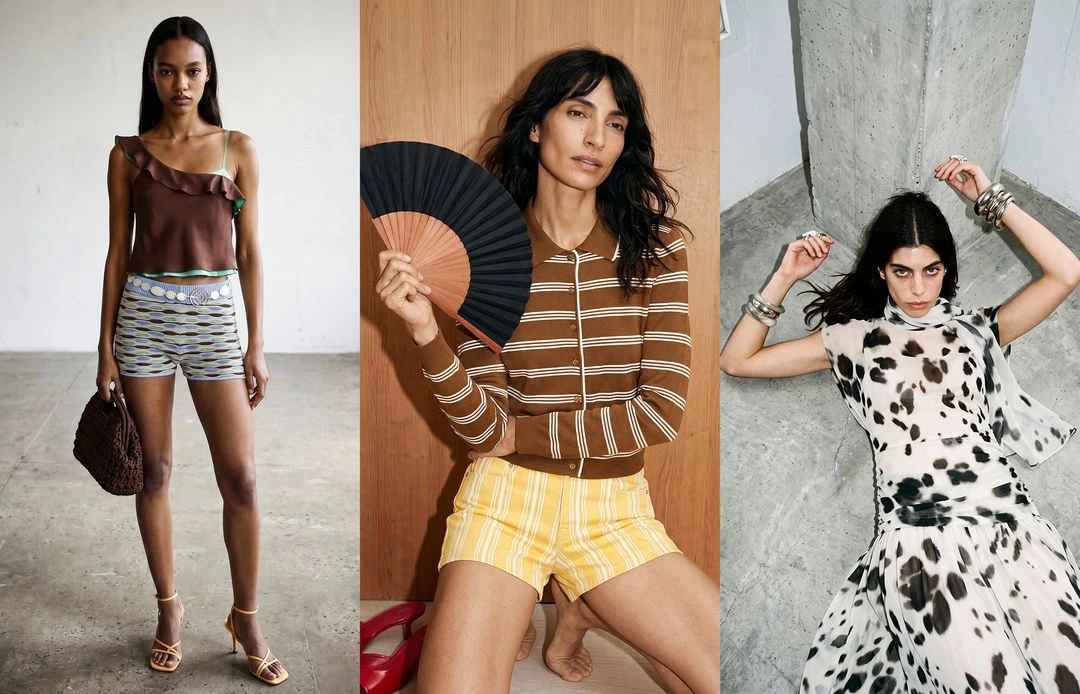
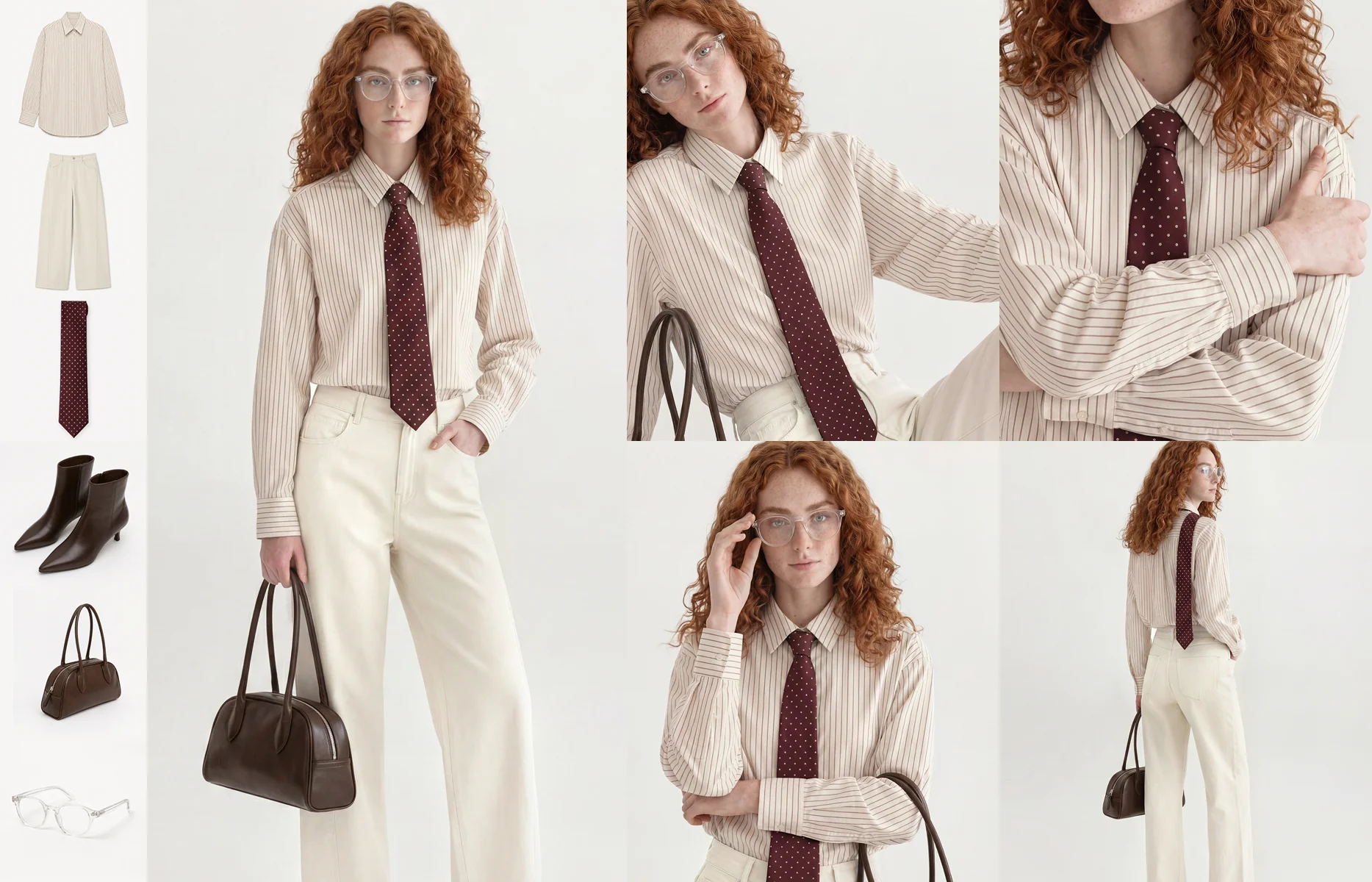
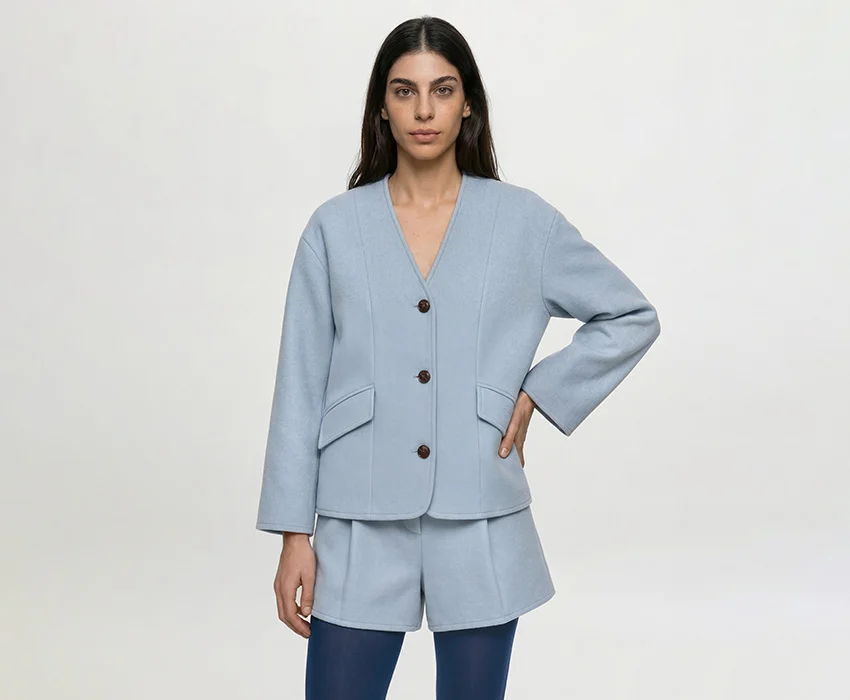
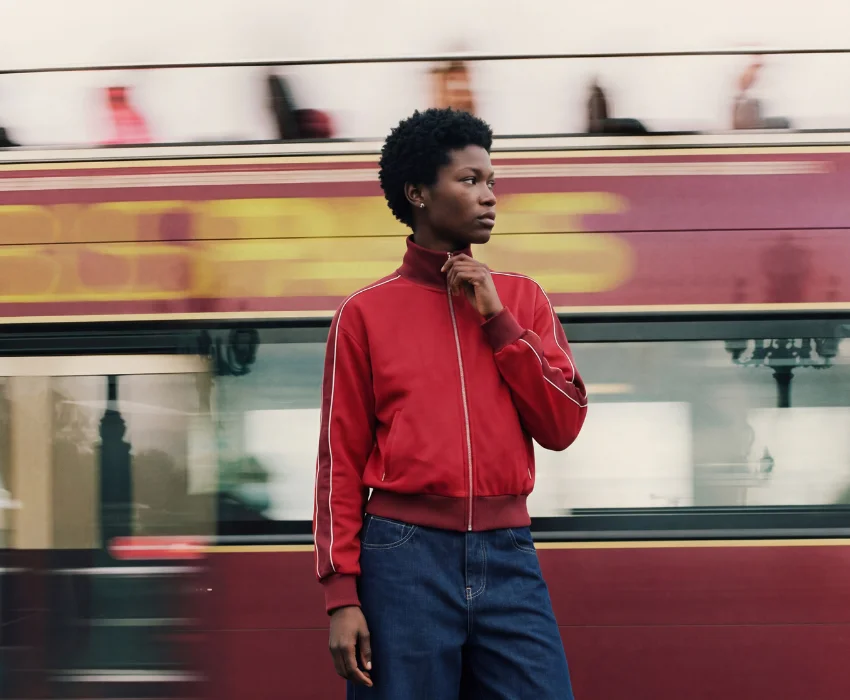
In practice, that profile is built from three things. The first is a defined, exclusive set of brand-owned AI avatars, so the same faces and bodies appear consistently instead of a new person every time. The second is a set shot list: poses, camera views, and cropping fixed once and reused, so framing does not wander from one SKU to the next. The third is calibrated lighting, locked to the brand's standard and applied across every generation.
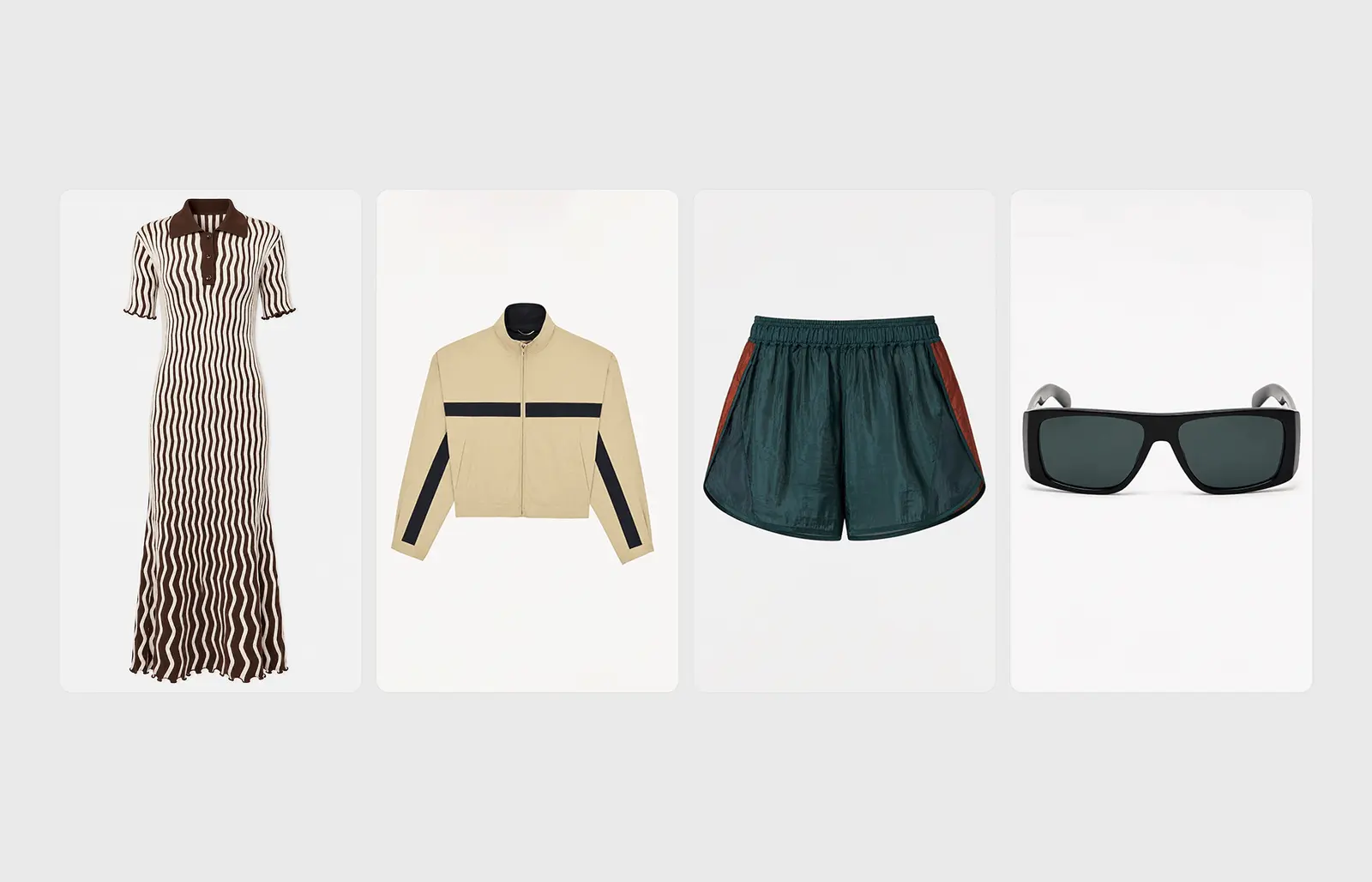
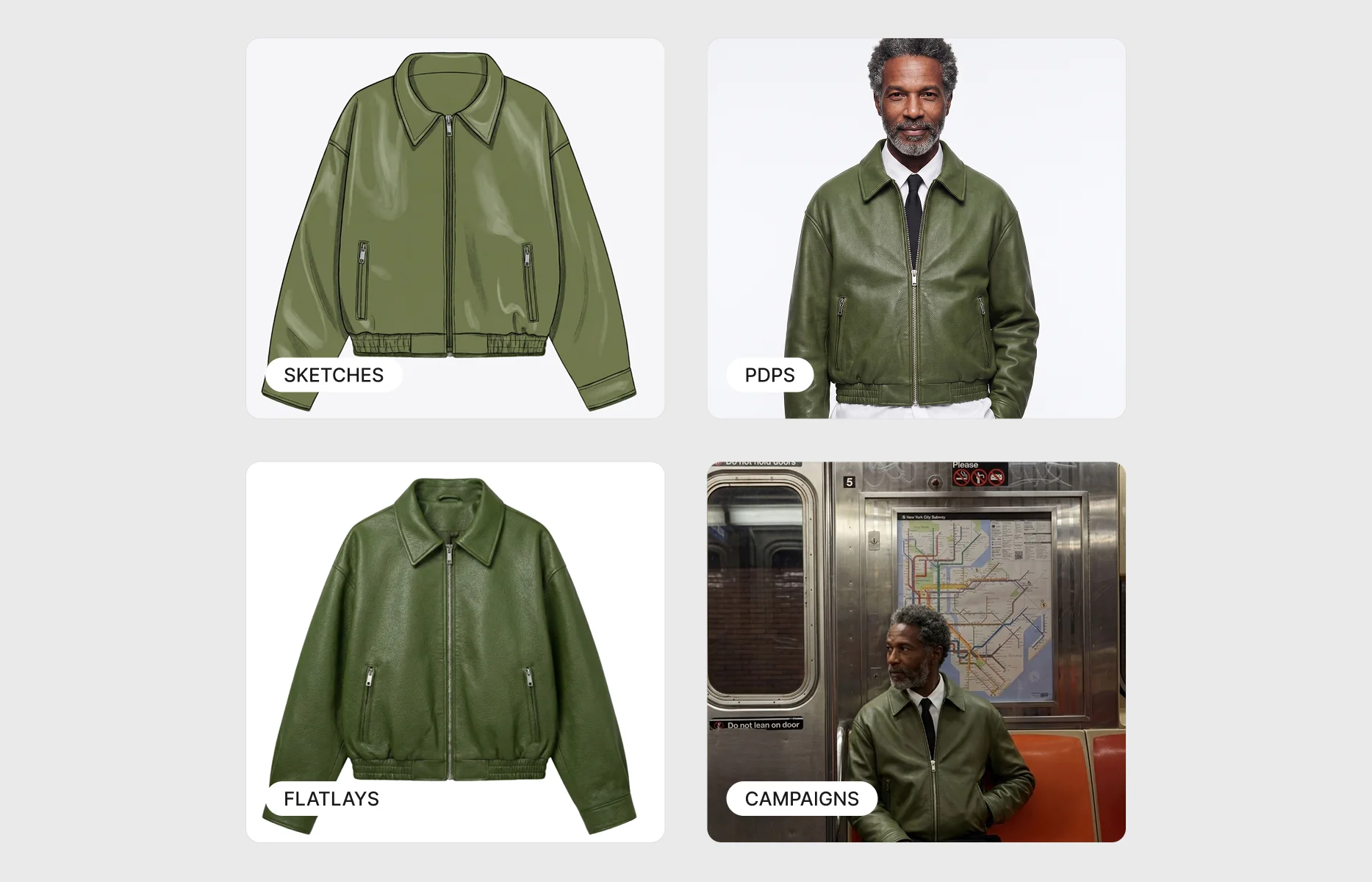
Once those are set, consistency stops being something you chase on each image and becomes something the system enforces by default. Extending a campaign's visual language to a colourway that was never shot, or to the long tail that never made the schedule, becomes a matter of running existing inputs through the same locked profile. A brand can turn packshots and flat lays it already has into on-model imagery at catalogue scale, and every one of those images inherits the same avatars, poses, and lighting as the hero styles. The consistency is inherited, not recreated.
Keeping garments, logos, and prints accurate
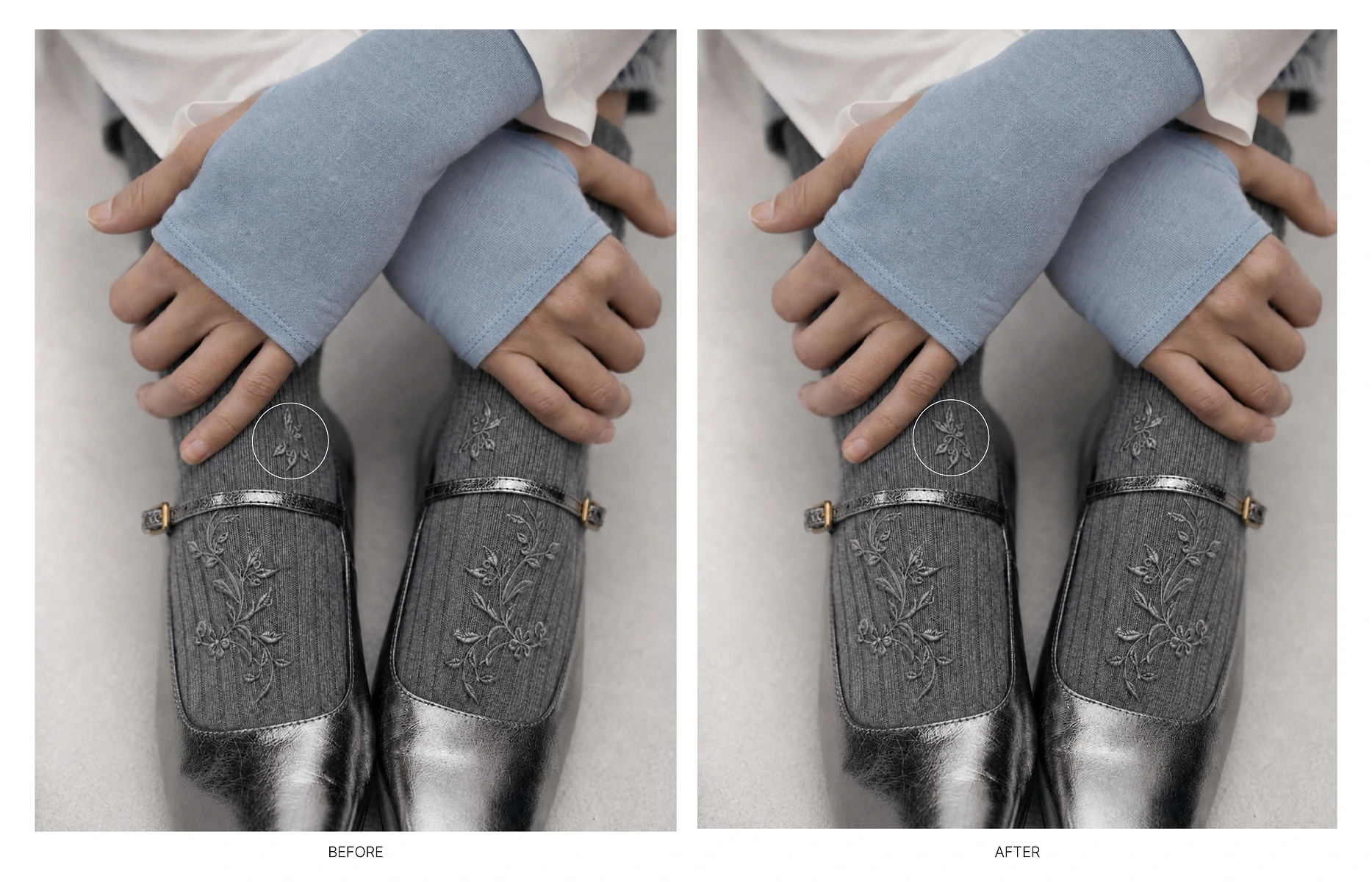
Consistency is not only about the model and the frame. It is about the garment reading correctly: the logo crisp, the print aligned, and the trim and hardware right. This is where general AI fails most visibly, and where it does the most brand damage, because a distorted logo is instantly recognisable as fake and undoes the credibility of the whole image.
The approach that holds up is targeted correction rather than brute-force regeneration. Fixing logos and product details directly, without regenerating the whole image, keeps the garment true to the physical product and avoids reintroducing new errors with every new roll of the dice. It is a small-sounding capability that carries a lot of weight, because on-model imagery only earns its place if the product on the model is unmistakably the product the customer will receive.
Holding the standard over time, not just at launch
A catalogue is not a one-off. New collections drop every season, colourways expand, markets diverge, and the standard has to survive all of it. Two things keep it holding.
The first is a review and calibration layer. In-platform review and approval means imagery is checked against the standard before it goes live, so nothing off-brand slips through. A dedicated team calibrating the brand profile means the look is maintained as the catalogue grows, rather than drifting as different people generate different things at different times. This is the difference between a tool an individual operates alone and a process with expertise behind it, and it is usually the difference that decides whether AI imagery holds up past the first season.
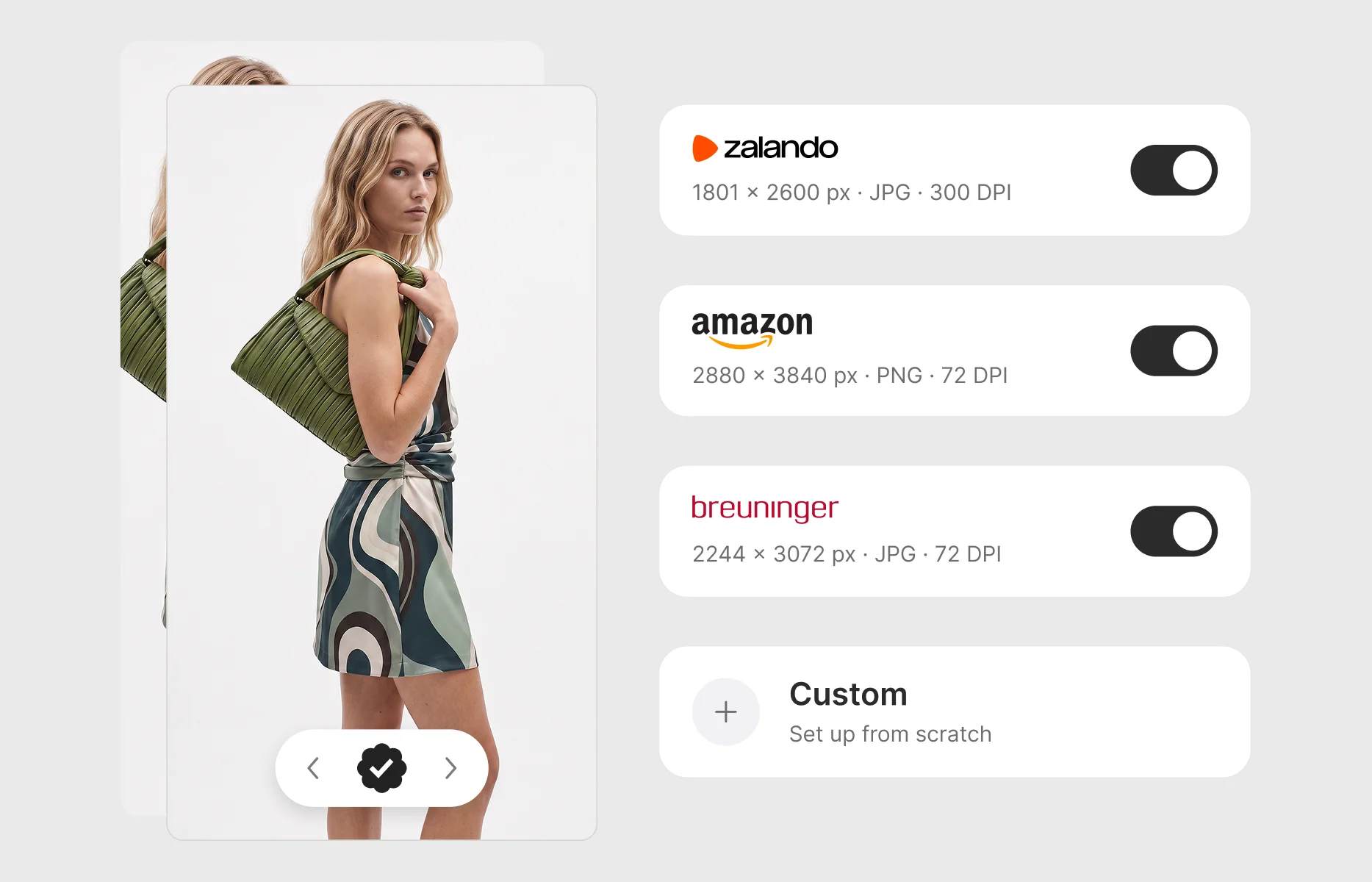
The second is integration with the systems the brand already runs. When imagery is tied to product data, to SKUs and product descriptions, and flows through the brand's PIM and DAM, consistency becomes a property of the workflow rather than of individual images. The right picture stays attached to the right product, across every channel and market, without manual reconciliation. Consistency of process, not just consistency of pixels.
When consistency is handled this way, structurally, the old constraint that forced brands to choose between creative range and production reality loosens. Colourways, market variations, and seasonal updates that never justified a shoot become viable, and every product, not only the hero styles, can carry the brand's full visual standard. Consistency at scale stops being a compromise and starts being the thing that makes broader creative range affordable.
Frequently asked questions
What causes AI-generated fashion imagery to look inconsistent?
Most inconsistency comes from generating each image in isolation. General-purpose AI has no persistent memory of a brand's look, so faces, bodies, lighting, and cropping change from one image to the next, and garment details such as logos and prints distort. The result is a set of unrelated one-offs rather than a catalogue with one visual standard.
How do you keep AI on-model imagery consistent across a large catalogue?
By calibrating the brand's look once and applying it automatically. A fixed set of brand-owned AI avatars, a set shot list of poses and camera views, and calibrated lighting are locked in, then reused across every SKU. Consistency becomes something the system enforces by default rather than something each image has to earn.
Can AI keep logos, prints, and garment details accurate?
Yes, when the approach corrects those details directly instead of regenerating the whole image. Targeted logo and detail correction keeps the garment true to the physical product and avoids introducing new errors, which is essential because a distorted logo instantly reads as fake.
Why does consistency break when a campaign extends across colourways and markets?
A campaign fixes a precise visual language for the hero styles, but the colourways, secondary placements, and long-tail products are usually produced separately and later, often with different tools. Without a locked, reusable brand profile, each extension drifts a little further from the original, and the campaign's look fragments across the catalogue.
Does keeping AI fashion imagery on-brand require a technical team?
No. The technical work sits in calibrating the brand profile and integrating with existing systems, which is handled once. Day to day, production and e-commerce teams direct the look and review the output, without needing technical expertise to keep imagery consistent.
Ready to hold one standard across your whole catalogue?
See how Graswald AI keeps on-model imagery consistent across every SKU, colourway, and market, from the inputs you already have. Book a demo and we will show you brand-calibrated on-model imagery on your own styles.
.webp)


-p-1600.webp)

.webp)