.webp)
Why fragmented tools are slowing fashion content production - and how Graswald AI fixes it

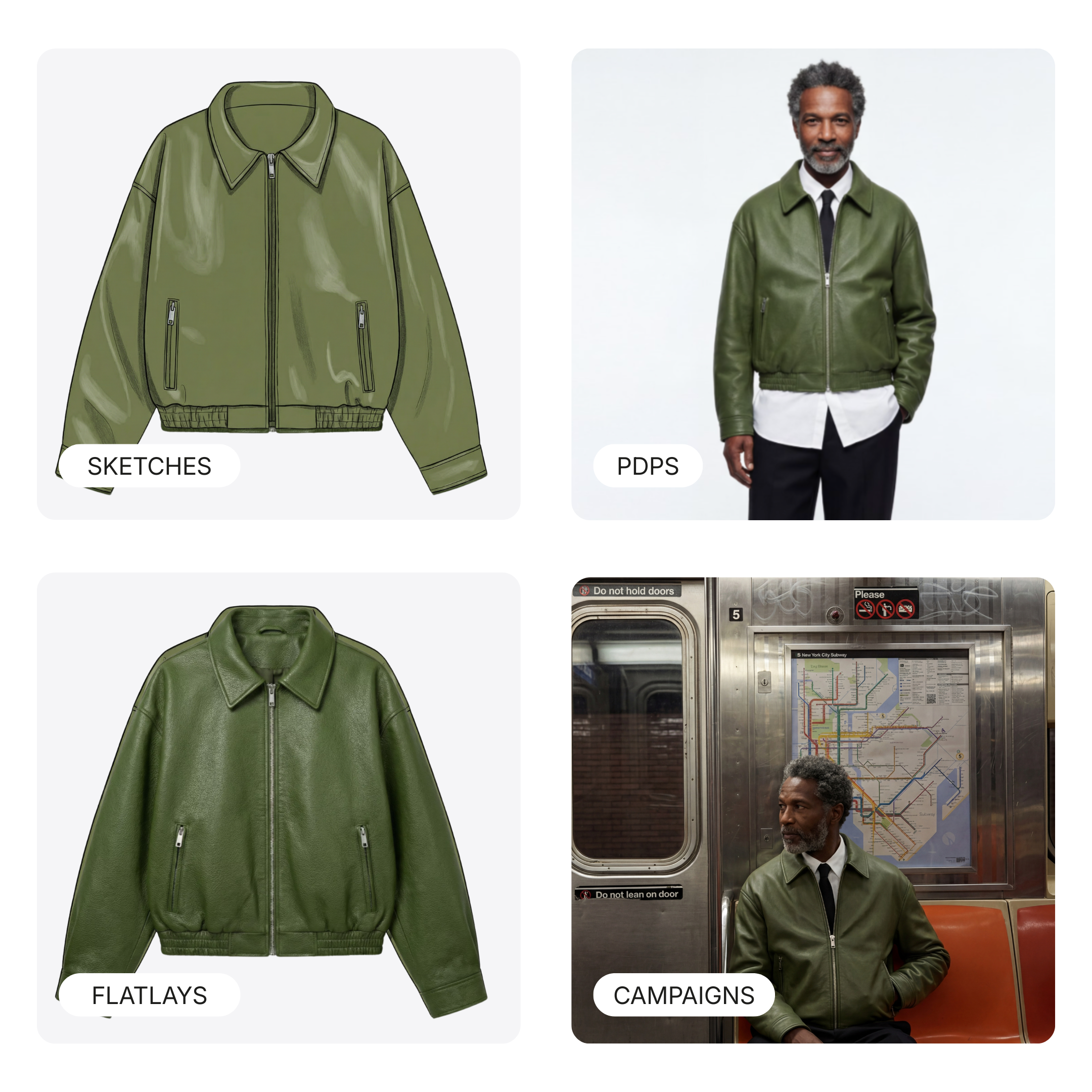
Modern e-commerce brands need more content than ever - for different markets, channels, and customers - but outdated or poorly integrated tooling makes it hard to maintain quality when producing at scale.
Fashion brands' tech stacks are often a patchwork of disconnected Product Information Management (PIM), Digital Asset Management (DAM), and CMS systems. General-purpose AI tools like Gemini get thrown into the mix, but they lack the guardrails and workflow integrations to maintain brand fidelity at volume. That is a key reason why only 1% of fashion brands have achieved maturity with their AI rollout.
Graswald AI solves this not by replacing the tools your teams already rely on, but by integrating directly with them. It connects to your existing PIM and DAM and layers in AI image generation purpose-built for fashion e-commerce - so teams can move rapidly from early creative sketches to studio-quality imagery, all within the workflows they already use.
Why having content production spread across scattered PIM, DAM, and CMS tools is so inefficient
Using a mix of tools that are not well integrated means creative teams lack efficient, consolidated workflows. The result is more manual work, slower content production, and serious difficulty maintaining quality standards at scale.
As Yannick Kwik, Sales Lead at Graswald AI, puts it: "Tool fragmentation is a big operational challenge that all brands are seeing... The problem is that all this information is now spread across different platforms. The CMS for the website, the DAM for assets, a PIM with pricing information connected to the website - and the information needs to be dumped somewhere across all of it."
This means different departments using different platforms for different use cases, with information falling through the cracks between them. Creatives spend their time on manual tasks - searching for the correct file, checking for data errors, reconciling product information across systems - rather than producing content that tells the brand story.
The operational cost compounds quickly. When a shoot is complete, images need to be manually named, formatted, and transferred into the correct system. SKU data from the PIM has to be checked against what was actually produced. Approval processes happen over email or in separate tools. None of this is the work your production team was hired to do.
Why general-purpose AI tools like Gemini do not scale for e-commerce content production
Reaching for a tool like Gemini or ChatGPT to handle image generation can feel like a logical step for teams already struggling to meet high content demands. The low barrier to entry is appealing - minimal setup, flexible prompting, and results that can look impressive for smaller projects.
For enterprise e-commerce teams producing content at volume, however, these generic AI tools tend to worsen the fragmentation problem rather than resolve it. This is a key explanation for why up to 90% of fashion brands' transformative AI projects are stuck at the pilot stage.
Specific problems that general-purpose AI tools create for e-commerce content production include:
- They cannot maintain brand accuracy at scale. Purpose-built platforms are designed with guardrails that keep AI output within brand-approved parameters. Generic tools are not. Ask Gemini to generate an AI avatar, and you will get something different every time - a face that subtly shifts between images, a missing button, a garment pattern that is not quite right. Small errors that are invisible at low volume become a significant quality control problem when you are producing hundreds of Product Detail Page (PDP) assets.
- They sit entirely outside your existing workflows. An image generated in an isolated tool still needs to be manually named, formatted, and transferred into the correct system. For teams already managing content across multiple disconnected platforms, another unintegrated tool adds to the administrative burden rather than reducing it.
- They introduce compliance and security risks. General-purpose AI tools typically lack the enterprise-grade controls needed to prevent sensitive commercial data from being inadvertently exposed.
- The time savings disappear in post-production. Images that look clean at first glance often reveal product accuracy issues on closer inspection, sending creatives back into Photoshop to fix garments, background colours, and framing. At that point, the efficiency case for using the tool collapses.
The core issue is that general-purpose tools are designed for flexibility - to handle any task a user might throw at them. That is precisely what makes them unsuitable for enterprise e-commerce content production, where consistency, integration, and brand fidelity are non-negotiable.

How Graswald AI integrates with your existing content stack
Graswald AI is not a replacement for your PIM or DAM. It is an AI production layer that connects directly to the tools your teams already use, adding purpose-built image generation and workflow automation without requiring a rebuild of your existing stack.
The platform is API-first by design. That means Graswald AI can pull product data directly from your PIM - SKU details, colourways, product categories - and push completed imagery directly into your DAM, named and formatted to your specifications. No manual exports. No duplicate data entry. No version control headaches.
Different team members at various stages of product development work within the same connected environment - adding pack shots, creating sketches, and progressing assets from initial design through to shoot-ready and published. Because Graswald AI sits inside your existing workflows rather than alongside them, production decisions made in one part of the pipeline are immediately visible to every other team working on the same collection.
Which Graswald AI capabilities allow e-commerce brands to remove content production bottlenecks and errors
Compared to manual methods or a poorly integrated mix of tools, Graswald AI is built to make e-commerce content production consistent and efficient without disrupting the systems brands have already invested in. Here is how:
Brand libraries that lock in consistency across your catalogue
Unlike isolated AI tools that generate unpredictable results, Graswald AI uses centralised brand libraries to maintain brand fidelity across every SKU. These libraries house AI avatars, lighting presets, and studio backdrops that have been vetted and approved by your art directors. Every generated image draws from the same approved set - so the face, the lighting, and the brand aesthetic are consistent whether you are producing 10 images or 10,000.
Customised workflows built around your production rules
When we onboard brands, we configure the platform to match their specific requirements: image proportions and dimensions per view, head-to-frame distance, which views are needed for which product categories, and more. These rules are applied automatically in every production run, with no room for human error and no need for manual QA against a separate brief.
Automated file naming that connects to your DAM
Graswald AI automates exactly how each image is named - based on the product, colourway, and view - and pushes files directly into your DAM in the correct structure. That eliminates one of the most time-consuming and error-prone parts of post-production entirely. Every image from a session is saved and accessible, so teams can go back and select from alternatives without losing anything.
Targeted AI editing after the fact
Graswald AI also gives brands the ability to make targeted edits to specific images after they have been generated - adjusting a styling detail, swapping a background, or modifying a single view without reshooting. That kind of precise, post-production control is not possible in a traditional workflow, and it is not something general-purpose AI tools support at all.
The bottom line: why integration matters more than replacement
Relying on a fragmented tech stack is no longer sustainable for brands managing thousands of SKUs across global markets. But the answer is not to replace the systems your teams depend on - it is to connect them properly and add production capability that works within them.
General-purpose AI tools increase the chaos. They generate inconsistent output, sit outside existing workflows, and create more manual work in post-production than they save upfront.
Graswald AI takes a different approach. By integrating directly with your PIM and DAM, automating the error-prone parts of production, and locking in brand standards through centralised libraries and customised workflows, it gives your creative and production teams the infrastructure to produce studio-quality on-model imagery at scale - without rebuilding their stack or learning a new system from scratch.
See Graswald AI in action. Book a demo now and find out how your team could be producing on-brand imagery at scale.
.webp)